
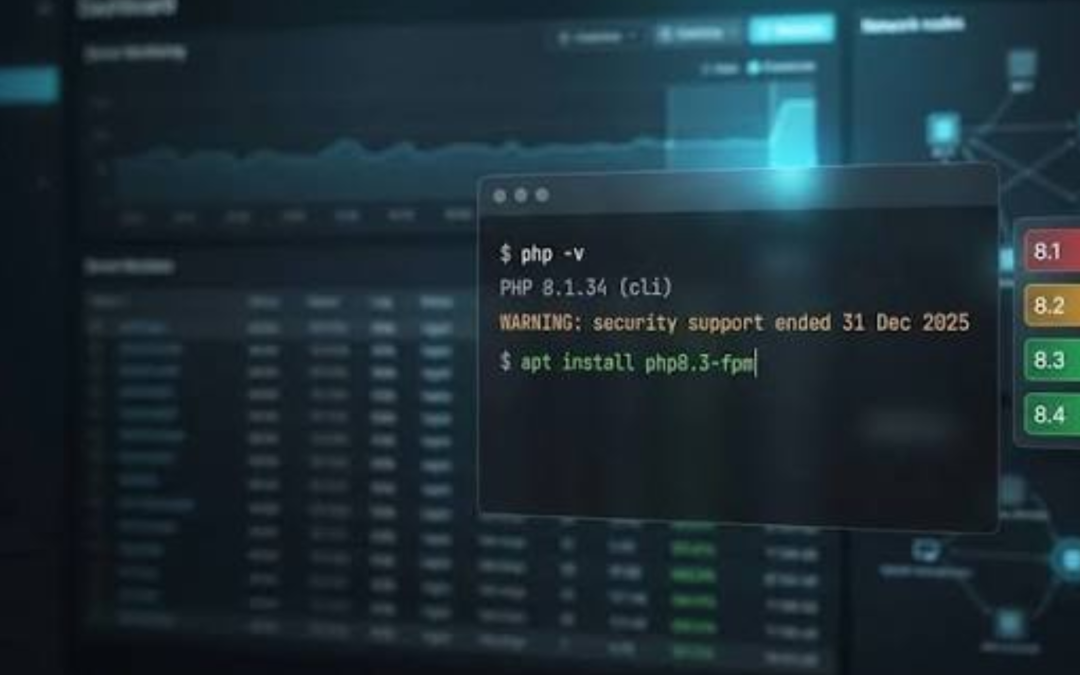
A company can keep its website, plugins, and applications up to date and still be exposed through the PHP runtime underneath them. That was the problem highlighted in October 2026, when two critical PHP vulnerabilities, CVE‑2026‑109618 and CVE‑2026‑109619, were disclosed. Collectively known as PHP2Shell, the flaws can allow an attacker to run code remotely on a vulnerable system without signing in. On October 26, the US Cybersecurity and Infrastructure Security Agency (CISA) added both vulnerabilities to its Known Exploited Vulnerabilities catalog.
Which systems are at risk?
The vulnerabilities affect unpatched PHP installations that serve web requests. Exposure can extend beyond public websites and online stores to customer portals, APIs, and third-party products that include PHP as a component. A business may therefore depend on PHP even when its IT team has never installed it directly. For managed services, the hosting or software provider may control when the fix is applied.
The first fixes shipped on October 21 in PHP 8.5.12, 8.4.27, 8.3.36, and 8.2.35. PHP 8.1 and earlier branches had already reached end of life. PHP issued additional security fixes on November 19, so businesses should use the latest security release for their supported branch or confirm that their provider has applied the applicable fixes.
What could a successful attack mean for a business?
Remote code execution can give an attacker access to resources available to the compromised application. The consequences depend on what that application can reach and what permissions it has. An online store could face checkout disruption or unauthorized access to order records. A customer portal could expose confidential files. If the application has access to credentials or other internal systems, the impact could extend beyond the original server.
A site can still appear to function normally after a compromise. Businesses that ran an exposed, vulnerable instance should review activity from the period before patching and investigate suspicious changes, unexpected file activity, and unusual behavior from PHP processes.
How businesses can reduce their exposure
- Find every system that uses PHP. Include public and internal applications, staging environments, containers, and vendor-managed services. Record the version, who is responsible for updates, and whether the system is reachable from the internet.
- Patch internet-facing systems first. Apply the latest available security update for each supported branch and verify the version running in production. For hosted or bundled PHP, ask the provider which services were covered and when the fix was applied.
- Take vulnerable services offline if they cannot be patched promptly. CISA recommends this for systems that cannot be updated immediately, including those on unsupported PHP versions. A web application firewall may provide temporary protection while the update is prepared.
- Check for signs of compromise after patching. Review web, application, and endpoint logs for the period of exposure. If the evidence points to a compromise, isolate the affected system, preserve relevant logs, and activate the incident response process.
How N‑able responded
N‑able reported that it put temporary protections and additional monitoring in place while patching affected services. In its October 22 update, the company said it had secured all relevant products across the PHP versions supported on its platform. Its advisory identified Take Control session routing, N‑sight, Mail Assure / Spam Experts, and Passportal as within scope. N‑able also noted that its temporary protections could affect some file upload forms.
For IT teams and managed service providers, the practical question is whether they can account for every PHP deployment they depend on. An up-to-date inventory, clear responsibility for patching, and confirmation from hosting and software providers make it possible to answer that question quickly when the next advisory arrives.
Follow us to learn more
CONTACT US
Let’s walk through the journey of digital transformation together.

